

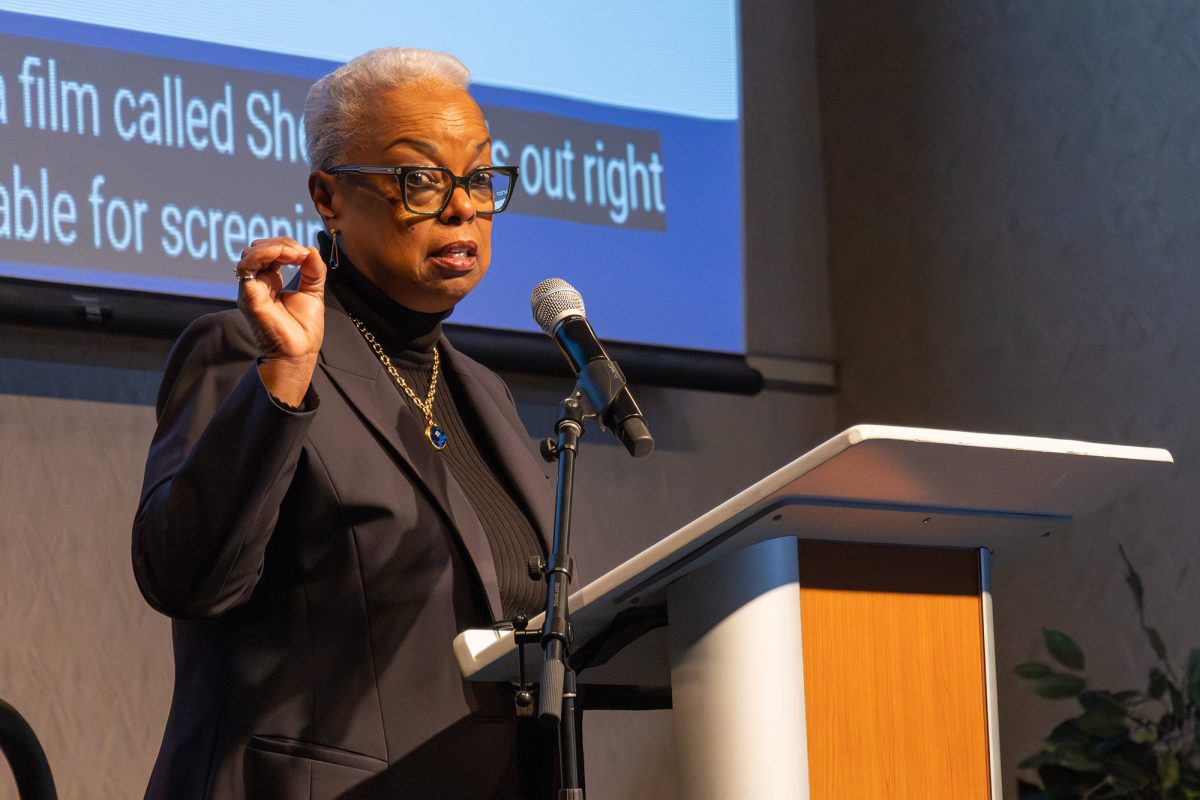
Ithaca College administrators asked students, faculty and staff gathered during the Feb. 26 State of the College meeting to “hold on” as they work to reduce the college’s budget deficit through decreasing expenses, increasing revenue and maintaining steady enrollment.
Administrators shared projections about enrollment, finances and philanthropy, and updates from the February IC Board of Trustees meeting and the Middle States Commission on Higher Education reaccreditation process for the crowd gathered in Emerson Suites.
Finances
Rakin “Rock” Hall, vice president for enrollment management and student success, said his team has worked to encourage more prospective students to apply earlier in this year’s application cycle. Hall’s slide showed that the college has received about 14,000 applications — 22% ahead of its goal.
However, the college has only received 222 deposits for Fall 2026, which is a 7.5% decrease from this point in the 2025 cycle. Hall said his team is focusing on increasing the yield rate, which is the percentage of admitted students who decide to enroll. According to Hall’s slide, the yield rate is currently 2.48%, compared to the goal 13% yield rate.
“That’s nothing to fret about,” Hall said. “More people look at us sooner, so we understand that teams will behave in slightly different ways in this cycle. … I am very confident, as the IC family, we will land this class.”
Tim Downs, senior vice president and chief financial officer, said he projects the college’s budget deficit will decrease from $9.6 million at the end of fiscal year 2025 to $8.5 million at the end of FY 2026 because the college met the Fall 2025 enrollment goal. This would come in below the $9.2 million projected deficit that the Board of Trustees approved for the FY 2026 budget.
Downs said the college is working to decrease the deficit to $4 million by the end of FY 2027 and eliminate the deficit by the end of FY 2028. The college has been implementing guidance from the administrative analysis study with the Huron Consulting Group — which concluded in June 2025 — to reduce expenses and increase revenue.
Chad Tessier, interim vice president of advancement said that with four months left in the fiscal year, the Division of Advancement has raised $13.2 million in new commitments, surpassing its FY 2026 goal of $10.3 million. The division has also raised $9.39 million in cash flow, exceeding its goal of $8.25 million.
The college has raised about $598,000 out of its $1 million goal for the general IC Annual Fund and about $924,000 out of its $1.4 million for the unrestricted IC Annual Fund, according to Tessier’s slideshow presentation. Tessier said the Division of Advancement hopes to raise the rest of its goal through Giving Day on April 23 and 24.
President La Jerne Cornish said administrators are working to make realistic and sustainable giving projections and campaign planning goals, and develop infrastructure that can maintain steady donations in the long term.
Downs said the college has made the bulk of the expense reductions during FY 2026 but will continue to make reductions in FY 2027 and 2028. Downs said that once the Fall 2026 enrollment numbers come in in May, he will have a clearer view of how much the college needs to reduce expenses in FY 2027 to meet the $4 million budget deficit goal.
“We appreciate that a lot of this is very fluid, as we continue to see not only what our incoming class is, [but] what is our retention in our existing student body, what is the discount rate?” Downs said. “We look at all those factors as we look to land and have students not only come to college, but graduate from Ithaca College.”
Search committees
President Cornish began her remarks with an update about two executive searches.
The college announced in December 2025 that Kirra Micheler (formerly Franzese), chief human resources officer and associate vice president of human resources, asked to step back from her role. The college launched a national search to fill the chief human resources officer position.
Cornish said the search committee is chaired by Marc Israel, associate vice president for business and finance, and includes faculty and staff from across the college. The search committee plans to select semi-finalists for the position in early March and interview them during the week of April 6.
The college will work with Diversified Search Group to search for a new vice president for the Division of Advancement. Tessier is serving as interim vice president for the Division of Advancement following Laine Norton’s departure for Hofstra University on Jan. 30.
Cornish said Stanley Bazile — vice president of student affairs and campus life — and Paula Younger — executive director of government, community and constituent relations — will co-chair the search committee. Cornish previously announced that the college hopes to fill the role by July 1, and said during the presentation that the search committee will announce a search timeline soon.
Reaccreditation
Melanie Stein, executive vice president and provost for academic affairs, gave an update on the college’s progress through the Middle States reaccreditation process. Stein said the Middle States Steering Committee submitted the self-study report for the Middle States Commission on Higher Education and is now preparing for the March 29 through April 1 site visit.
Stein asked campus community members to review the self-study report, discuss it with colleagues and think about how the narrative described in the report relates to their division.
“We all know … the past five, seven years have been particularly challenging,” Stein said. “[Our] self–study tells that story, and we framed it in terms of the resiliency of this institution and how we have faced those challenges and seized them as opportunities and leveraged them to help support our mission and goals.”
Stein said the steering committee will host several drop-in information and practice sessions to help campus community members prepare for the reaccreditation visit.
Communication with campus community
During the question section of the event, sophomore Sam Knight asked Cornish if she has plans to incorporate student feedback into discussions about the direction of the college.
Cornish said she is working with Rishabh Sen, president of the student body, to plan a town hall meeting, which would gather the Student Governance Council e-board and president’s executive council for a discussion with students.
John Witkiewicz, mental health counselor in the Center for Counseling and Psychological Services, said CAPS staff members learned that the college is planning to reduce CAPS staff by one counselor in Fall 2026, and one of CAPS’ administrative assistants has been offered another position or they will be laid off. Witkiewicz noted that Cornish agreed to share information about divisional staffing changes following a request from Sara Levy, former chair of the Department of Education, during the May 2025 State of the College meeting. He asked if the college had made progress on that commitment.
“Where as a community can we learn about the people we’re losing and the people that are moving and the impacts that that might have to our programs?” Witkiewicz said. “What is the administration doing to share with current and prospective students how these changes might impact them?”
Cornish said administrators have always said that they will not publicize information about whose positions are lost.
“We will continue to provide the best services that we can provide with the people that we have as we continue our efforts to align the size of the faculty and staff with the student body on our way to budget neutrality and then beyond balance,” Cornish said. “Until we get there, this is the work that’s in front of us and the work that we face.”
Cornish said that reducing the size of the institution to match the 4,500 target student body size identified in the administrative analysis study will not be easy, but it will be worthwhile. She asked the crowd to contribute to the college’s yield rate goal by being especially welcoming toward admitted students.
“Right now, students are trying to decide where their home is going to be for the next four years, and I don’t know about you, but I can’t think of a better home than Ithaca College,” Cornish said. “Thank you for who you are, thank you for what you do, and as I always say, the best is yet to come. Hold on.”