

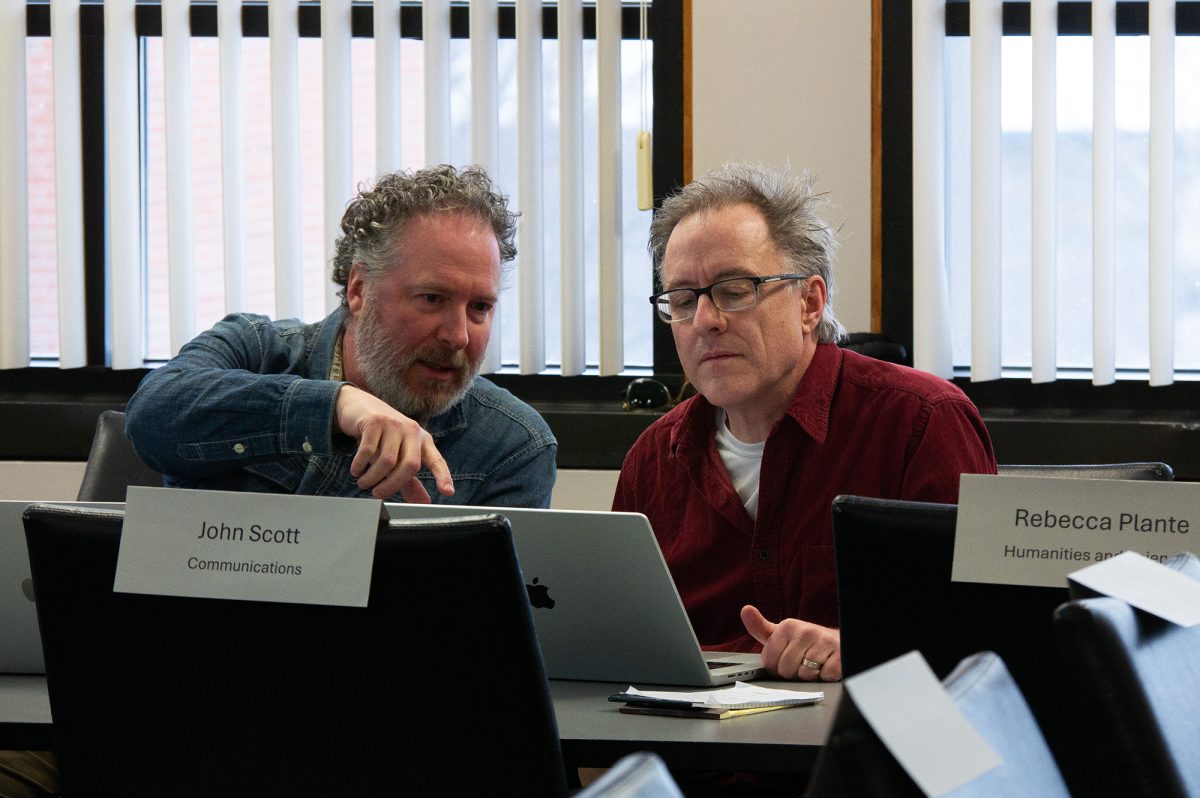
The Ithaca College Faculty Council met Feb. 3 to hear updates from the provost regarding a pause on faculty hiring and to discuss the Middle States Commission on Higher Education Reaccreditation process.
Provost Report
Melanie Stein, executive vice president and provost for academic affairs, gave the provost report regarding current staffing issues. Stein said the current faculty is too big for the student body by about 40 full-time equivalent faculty. Stein said this number has been tried to be brought down through strategic allocation of the vacated positions. In 2026, the college will no longer hire anyone to fill these vacancies.
“We have this 40 faculty gap, but we still feel like we’re not fully staffed,” Stein said. “[This] means something’s gotta give and there are still changes that need to be made, maybe not everywhere but in a lot of places that [will] have curricular adjustments.”
Michael Trotti, professor in the Department of History and legal studies coordinator, said that reallocation through attrition is beneficial because it does not remove a program completely and instead downsizes it. Attrition refers to the gradual reduction of faculty over time through not replacing workers after they retire or resign.
“Is any school at its best when it’s a 4,000 student school based on a model of a 6,000 student school?” Trotti said.
Stein said the staffing issue is being looked at in different ways. One of these is a top-down approach that the college has used in the past, resulting in closed departments. Stein said merging departments that share similarities is another solution.
“It is happening in parts of the institution … I don’t want to say anything identifying, but there is a little part of the institution that was trying, in the opinion of the administration, to run too many different programs,” Stein said. “They didn’t have enough students to justify it [and] the students were too spread out.”
Stein said part of the solution includes that when a staff member leaves, they will no longer be replaced by contingent faculty. She said this, combined with strategic attrition, will remove the faculty gap.
“That means adjusting how you deliver your curriculum, be it by within your programs or looking more across the college to your colleagues and saying, ‘how can we choose to do this whole thing differently?’” Stein said. “We all need to be doing that work.”
John Scott, associate professor in the Department of Media Arts, Sciences, and Studies and documentary studies program director, asked Stein how this change of faculty distribution has affected student enrollment in courses. Stein said that currently, the college is trying to maintain consistency across course registration.
“We should not be running classes with five students; we cannot afford that,” Stein said. “It’s hard to see because we also have huge classes that are busting out.”
Middle States Reaccreditation Process
The reaccreditation process is conducted every eight years and evaluates the college on factors such as financial stability, academic effectiveness and student experience. Ithaca College uses the Middle States Commission on Higher Education as an independent evaluator. Accreditation gives higher education institutions eligibility for federal financial aid and gives credibility to the degrees presented at that institution.
Te-Wen Lo, professor in the Department of Biology and a co-chair of self-study with the Middle States Commission on Higher Education, presented a guide that went over the accreditation process. This process includes upcoming evaluation visits that will happen at the end of March.
Council chair Dennis Charsky, professor in the Department of Strategic Communication and the director of the communication strategy and design program, asked Lo if there were any areas in the study that showed room for improvement and any areas where the college excelled. Lo said there was room for improvement within IC’s Integrative Core Curriculum courses.
“It doesn’t have to be perfect,” Lo said. “We [just] have to demonstrate the process and where we are in that process.”
Lo said IC was excelling in the “support of the student experience” section, which heavily outlined the many resources provided to students. She said these resources are always evolving to support the changing landscape of students.
“This campus is really good at integrating inclusive accessibility and diversity practices into everything that we do,” Lo said.
The council then moved to an executive session, which is limited to only members of the council.
The Ithaca College Faculty Council meets from 4-6 p.m. on the first Tuesday of every month in the Taughannock Falls Room of the Campus Center. The faculty council can be contacted at [email protected].