

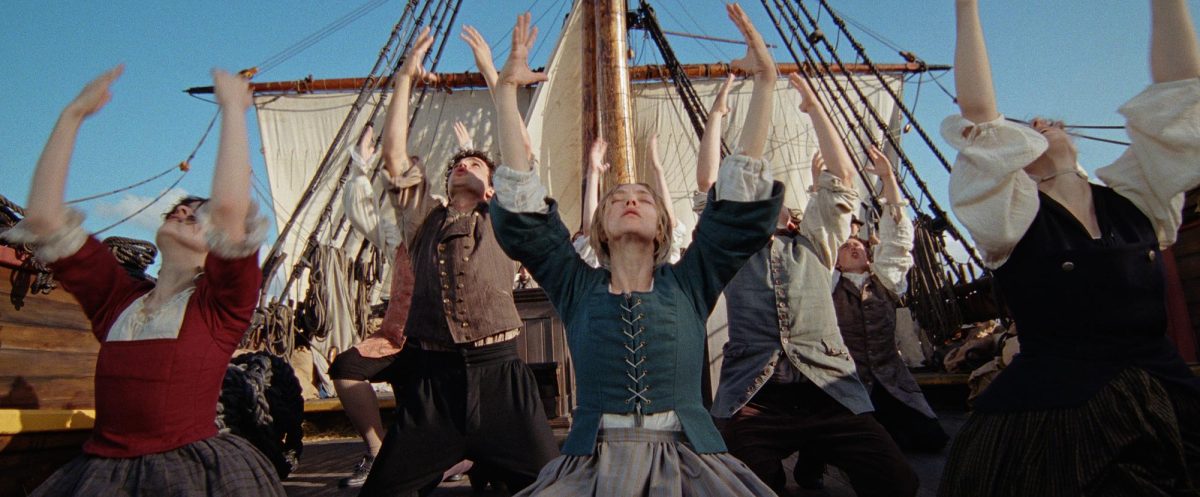
Following its limited theatrical release Dec. 25, director Mona Fastvold’s epic historical drama “The Testament of Ann Lee” expanded nationwide on Jan. 23.
The film follows Ann Lee (Amanda Seyfried) as she shapes the Shakers — a religious sect who use song and dance as their prayer — in England throughout the 18th century, acquiring the nickname “Mother Ann” and being embraced as the second coming of Christ.
“The Testament of Ann Lee” begins by illustrating Ann’s religious beliefs. After seeing her parents engaging in sexual intercourse at a young age and believing her father injured her mother, Ann associates the act with sin. As an adult, she becomes a fixture in the Shaker community and feels a stronger spiritual connection to God. When her visions of Adam and Eve bring her to the realization that fornication was the “original sin,” the Shakers accept Ann as the female Messiah. Moving to North America with her followers, Ann faces trials and tribulations in her quest to spread her beliefs.
Seyfried is a tour de force as Ann, a woman who becomes a god to everyone around her. Despite being known for her performances in the musicals “Mamma Mia!” (2008) and “Les Misérables” (2012), Seyfried is unrecognizable as Ann. From her haunting silence to her electrifying screams, Seyfried captures lightning in a bottle and delivers the best performance of her career.
While it features other interesting characters, such as Ann’s brother William Lee (Lewis Pullman), Ann shines so bright that she casts a shadow over the rest of the film. Pullman is great in the few scenes where his character is in focus, such as the scene where he persuades folks in other communities to join and follow Ann.
Thomasin McKenzie has a small but notable role as Mary Partington, Ann’s close friend who also serves as the narrator. While McKenzie is an adequate narrator, the narration sometimes feels unnecessary and awkwardly placed.
Stacy Martin also plays a small, albeit important role as Jane Wardley, a founding member of the Shakers. Setting the precedent for a female preacher, Jane helps Ann not only realize her full potential, but fulfill it. Martin portrays Jane with a steady calm that impacts the viewer despite how minor her performance is in the overall story.
A period film, both the production and costume design add levels of beauty and realism to the overall experience. The hypnotizing cinematography by William Rexer shows the viewer a perspective of being a Shaker, emphasized by specific shots of Ann staring directly at the camera during musical sequences.
The editing, accomplished by Sofía Subercaseaux, is just as spellbinding as Ann herself. Throughout the film — specifically in its frantic musical sequences — Subercaseaux intercuts the past, present and future of the Shakers. In a memorable and haunting scene, the film intercuts Ann singing and dancing to the song “Beautiful Treasures” with her giving birth and losing her four children before they turn one.
The music, composed by Daniel Blumberg (who recently won an Academy Award for his work on “The Brutalist”), is incredible. The songs performed by the Shakers are dynamic, kinetic and wholly unforgettable. A highlight of the soundtrack is the hymn “All is Summer,” which plays when Ann and her followers are making the treacherous journey to North America.
The screenplay, penned by Fastvold and her partner Brady Corbet (who have worked together on multiple films for over a decade), expertly weaves together different moments of Ann’s life. After two hours, the script helps the viewer experience Ann’s life so thoroughly they feel as if they lived their lives alongside her.
Fastvold’s direction is mesmerizing and sublime. Capturing beautiful, painting-like images, Fastvold presents Ann’s life as one that has to be witnessed to be believed.
Through song and dance, Ann and her fellow Shakers enthrall both the characters and the viewers themselves. After watching “The Testament of Ann Lee,” the audience will fully believe in the Shakers’ beliefs, along with Ann’s beliefs herself.


