
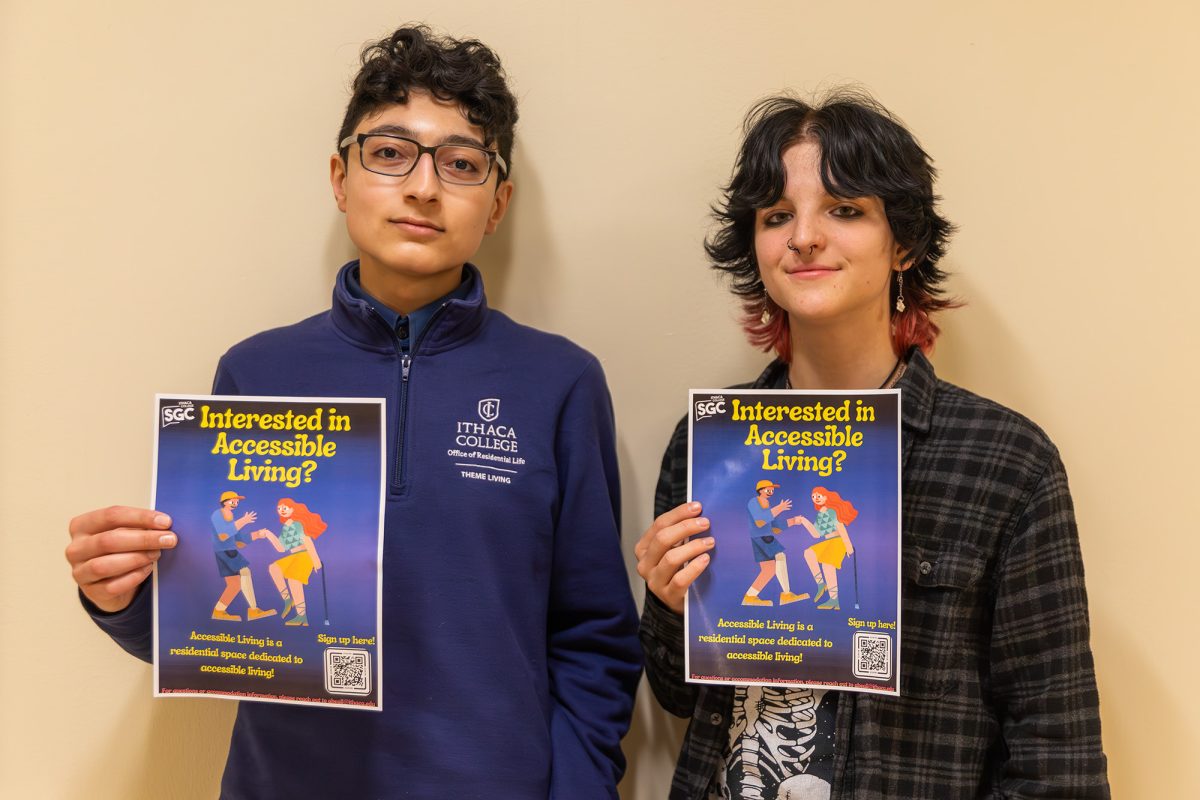
While the Residential Learning Community list has been released for the 2026-2027 academic year, some students at Ithaca College have been advocating for an addition: the Accessible Living RLC. The RLC is a proposition from sophomores Ty Sayahi and Ash Beall, both senators-at-large on the Student Governance Council.
An Accessible Living RLC would promote community throughout the disabled student community on campus. To do this, it is intended to be an RLC, rather than theme-based living for first-year students, to allow students from all stages of their college experiences to join. Otherwise, themed-based living and RLCs are identical in their goals to connect students with similar interests.
“The thing that made me think of the RLC as an option was that we don’t have a center for disabled students the way we do for LGBTQ+ students,” Beall said. “So I thought it’d be beneficial to have that safe space and to have people that could be asked ‘How do I navigate campus?’”
Sayahi and Beall said they seek interested students to advance in the process of making the RLC. Any student can initiate an RLC so long as they have a list of 25 or more students who have expressed interest in participating, as well as a proposal with goals and outcomes for the RLC. As of Feb. 16, they had collected 17 signatures via a Google Form through spreading the word and placing posters around campus.
Beall said they hope the Accessible Living RLC can be implemented by the start of the 2027-28 academic year. Beall said Beth O’Neill, director of the Office of Residential Life and the Office of Student Conduct and Community Standards, told them that with enough support, RLCs are typically implemented a year from when students propose it.
“The main goal right now is the student interest,” Beall said. “I’ve already had a couple people talk about maybe being the RA.”
The standard of accessibility varies widely depending on each student’s needs. Common housing accommodations include single rooms, elevator access, proximity to class locations, and emotional support animals.
Ian Moore, director of Student Accessibility Services, said he believed the RLC is awesome but that the location for a potential Accessible Living RLC might provide some challenges. IC is home to a large number of buildings constructed before the Americans with Disabilities Act of 1990, many of which cannot be easily upgraded.
“I don’t even know how to write down all the things that potentially could be a concern,” Moore said. “Obviously thinking about air conditioning, physical access and bathrooms primarily.”
To account for this, Sayahi and Beall have looked toward the first floor of either Landon or Eastman Hall, which were renovated during the summer of 2025.
“The advantage of the renovated Lower Quads is they have proper accessible bathrooms,” Sayahi said. “You can turn around a wheelchair in there. There’s a seat in the shower. … There’s the doors that automatically open in all the access ways, so it’s just a lot better. I don’t imagine anywhere else on campus, that I’ve heard of, that would be as good.”
Beyond housing itself, Sayahi said the lack of interest in other RLCs on campus opens a space for an RLC on accessibility. He said his experience as the RA of the STEM RLC involved only two students registered for it during the 2025-26 academic year. This has encouraged him to examine both RLCs and how housing is allocated to students at IC, particularly when it comes to disabled students.
“There’s definitely space to assign people that need the housing, and then you can put other people elsewhere,” Sayahi said. “I don’t see a reason that they wouldn’t have it, unless it was a budgeting issue.”
There is a large population of disabled students at IC, inspiring various groups such as the Disabled Students’ Alliance and Peer Leaders for ADHD Study Sessions. Moore said an Accessible Living RLC could be beneficial to IC, citing that disabled students on campus have a tight-knit community and increasing rates of disabled students getting accepted into IC.
“I see a lot of lifeblood,” Moore said. “I see a lot of people. … I see a lot of people across all of the various bits and bobs of campus, and it doesn’t matter what school you’re in [or] what year you are.”
Moore said that with a significant portion of IC students either directly identifying as disabled or otherwise having a condition that creates barriers between them and complete access to IC, an Accessible Living RLC would attempt to shorten the gap between students and their goals before graduation. During the 2024-25 academic year, over a quarter of IC students reported having at least one disability.
“You have a connection to people almost instantaneously, and then you are going to be able to communicate more and again, some of that will be like you’re in a stressful situation, you’re in a tough situation and you’re like, ‘Oh no, we’ve accomplished this before,’” Moore said. “‘I can share some supports.’ Some of it is just support, honestly. People just need to complain about things that aren’t good and that catharsis is helpful to have someone to hear you and listen to you.”