
The new thriller-comedy film “Forbidden Fruits” will not become a cult classic — yet. It is insanely camp and truly smart, but the bold genre-blending and all-encompassing reach leads to overwhelming storytelling that cannot resist piling on one more plot point or emblematic joke.
“Forbidden Fruits,” which was released in theaters March 27 following its premiere at South by Southwest Film Festival, follows a clique of girls who work at a boho-chic mall store called Free Eden (most definitely a Free People wannabe and a commentary on the cheugy culture of micro-trend fast fashion).
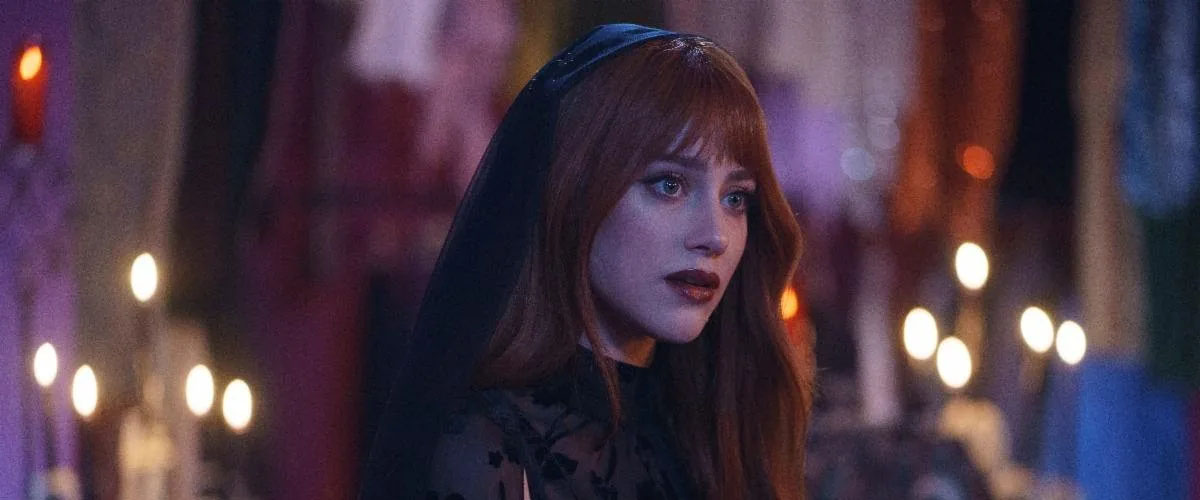
The girls are secretly a coven of man-hating witches whose seances create a haven of “paradise.” Apple (Lili Reinhart) is the Regina George-esque ringleader of the Fruits. Fig (Alexandra Shipp) and Cherry (Victoria Pedretti) are loyal followers who value Apple’s mentorship, but they also crave individuality.
The women describe their powers, which seem to only target men or any perceived threat to womanhood, as “the mundane s— that would have gotten you executed in Salem.” The headquarters of their conjured “paradise” is the upstairs of Free Eden, where a bejeweled cowboy boot serves as a makeshift cauldron, and their main chant is a plethora of trendy buzz words: “Goat’s milk, thigh gaps, rose petals, bone cast, truffle oil, bitch slap, blood clots, juice prep.”
Just as Apple inducts the eager Pumpkin (Lola Tung), a former member named Pickle (Emma Chamberlain) comes back to haunt Apple for sacrilegiously murdering her boyfriend. The girls start tasting the not-so-sweet implications of their group’s toxicity, and Pumpkin, Cherry and Fig begin to question personal histories and the true motives behind Apple’s cult-like leadership.
The film is based on Lily Houghton’s 2019 off-Broadway production “Of the Woman Came the Beginning of Sin and Through Her We All Die.” Meredith Alloway, the film’s director, rightfully saw the play as a depiction of women reclaiming their storied position in society as the foundation for humanity’s perception of evil and sin.
The story masterfully wields reinvented biblical archetypes and dry comedy to articulate the nuances within female friendship, spirituality, consumerism and social media-driven performative feminism. Every line of dialogue and unexpected costume satirizes trends, expectations and society’s insatiable need to define women within the bounds of the male gaze.
The writing and strong leading performances make “Forbidden Fruits” a cauldron of complex female characters. The Fruits are unapologetic, mysterious and intoxicating, but their allure is a facade for their irrevocable humanity. Apple — who, as her name suggests, is painted as the ultimate woman of sin — struggles with mental health and a sense of belonging. Cherry works to overcome stigma around female sexuality, while Fig advocates for her independence as she starts a new relationship.
Emma Chamberlain, who departs from her YouTuber origins for this cinematic debut, is a cheeky cameo that serves as a nod to the film’s attentiveness to internet culture and a trend-focused feminine audience. Reinhart clearly upped her game since her “Riverdale” days for her magnetic performance. Tung stands out as a rising star, to no surprise, fresh off her dominance from the hit television series “The Summer I Turned Pretty.” Pedretti is no stranger to the horror genre, and it shows in her navigation of a multifaceted character who encounters some serious gore by the end. Fig’s standoffish nature is a perfect way in for Shipp, who, conversely, enters into a horror role for the first time.
The group’s so-called “femme martyr” (basically their mascot) is an implied spiritual Marilyn Monroe, the ultimate apple of the male eye during the ’50s. The Fruits’ version of church is the Free Eden dressing room mirror, where they take turns talking to Marilyn (themselves) and performing a “confessional.” This setting also serves as a space for impactful flashback scenes to advance the plot.
Aside from playing with timeless motifs of religion and cult-like methodology, “Forbidden Fruits” features a list of hyperspecific internet references — more focused on the pandemic zeitgeist than anything super timely — from Witchtok to Selena Gomez’s Rare Beauty mascara.
It is hard to fault the painfully obvious product placement throughout when this film was made by an independent production company. “Forbidden Fruits,” produced by MXN Entertainment and Independent Film Company (IFC), was made under interesting conditions. While not attached to any major studio and filmed indie-style with night shoots at an open mall, it has the critically-acclaimed director of “Jennifer’s Body,” Diablo Cody, attached — not to mention some standout lead actresses — and just barely earned the spot in the top 10 for “Specialty Box Office” with a $1.7 million opening week. So while not a blockbuster in the traditional sense, the film benefits from an experienced lineup.
The film is wise to take notes from femme fatale royalty like “Pretty Little Liars” and quintessential chick flicks like “Clueless” and “Pitch Perfect,” but it struggles to tighten loose ends.
The in-tune quips are very astute, like Fig’s Ed Sheeran obsession or blaming everything on Mercury being in retrograde. Still, the plot feels too expansive at times, like when two characters uncover — with a rushed leap into gore — their relationship as long-lost half-sisters. With more thoughtful development, this could have been an interesting throughline about the importance of sisterhood, both literal and metaphorical, rather than an unsatisfying plot twist. As is, audiences are not able to develop emotional investment into either character’s parentage to warrant this twist.
Another mishandled plot point was a possible romantic connection between two of the Fruits, since a central focus within the dynamic of the group is this pair’s particular co-dependence and shared insecurities. While the pair shares a brief kiss, the moment is unexplained, abrupt and anything but romantic.
“Forbidden Fruits” casts an odd spell on its audience. Although its satirical tone makes the whole thing feel like a big joke, the entertainment factor gives it merit. Even when the film overreaches the bounds of genre, it has a stellar foundation in terms of its characters, motifs and themes that underscores its self-awareness and watchability. Despite its lack of streamlined direction, “Forbidden Fruits” is a fun watch and is so close to breaking real ground with its commentary. Perhaps the next generation of shoppers, who in a few years may return to malls, will worship this movie just as high schoolers do “Mean Girls” — the production team did recreate the iconic fountain, after all.