

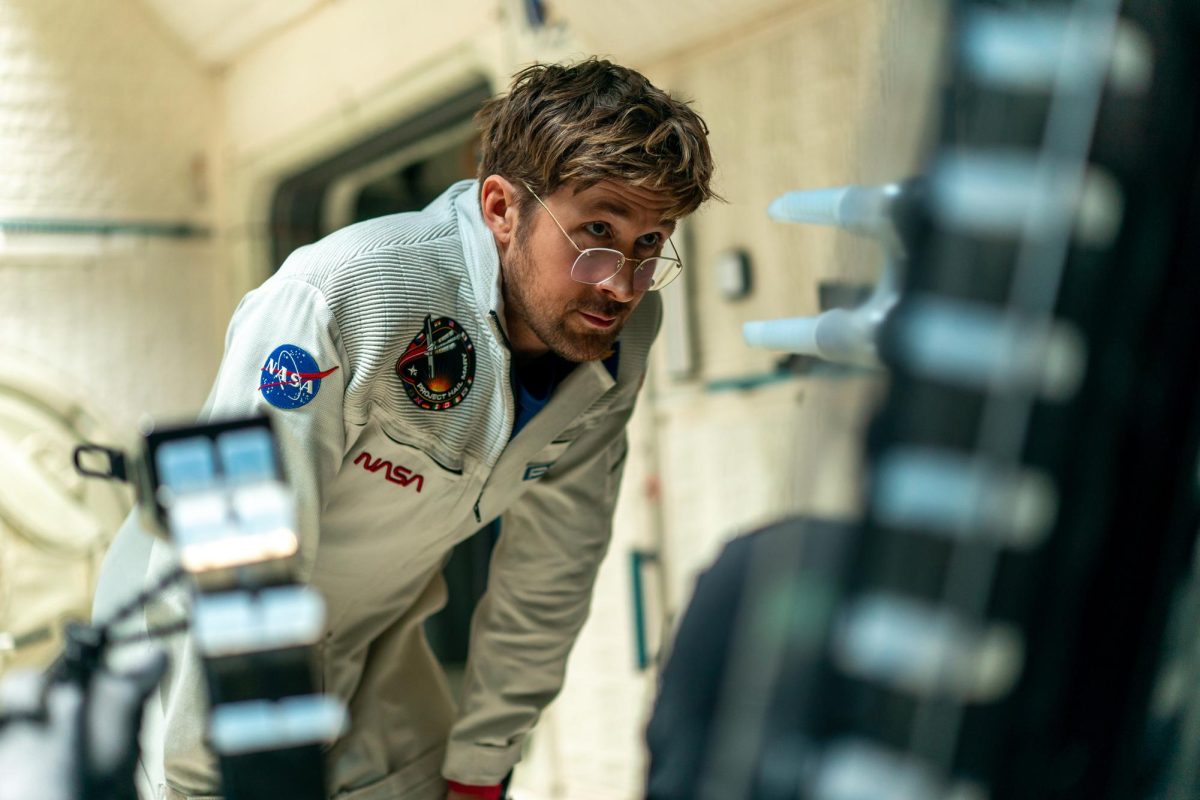
Directors Phil Lord and Christopher Miller lead an expert team of creatives to the stars in the highly anticipated adaptation of Andy Weir’s hard sci-fi bestseller “Project Hail Mary.” The movie, which blasted into theaters March 20 with a record-breaking opening weekend, has all the hallmarks of a Weir classic: accurate science, nailbiting tension and shamelessly brilliant characters.
The story follows Ryland Grace, an amnesiac scientist who finds himself alone on a spaceship light-years from Earth on a high-stakes mission. Grace is not an astronaut (he will tell you so himself!), but the fate of humanity rests on his shoulders. All seems hopeless until he forms an unlikely bond at the end of the film’s first act.
Lord and Miller’s adaptation is funny, heartfelt and deeply human. The duo’s previous work on the “Jump Street” films and “Cloudy with a Chance of Meatballs” serves as a surprisingly great audition for their role as the directors of Weir’s existential bromance. Their dedication to practical effects and playful comedy shines through in the film.
Academy Award nominee Ryan Gosling gives a career-best performance as Ryland Grace, a disgraced biologist turned school teacher turned astronaut who is forced to muster courage he didn’t know he had. There is no better actor to portray Weir’s quippy, nerdy protagonist, and Gosling easily carries the film on his back. He dominates the screen time and perfectly balances Grace’s “cool teacher” vibe with the raw emotion of a man doomed to die in space.
A pitch-perfect performance from Academy Award nominee Sandra Hüller brings Eva Stratt, the seemingly all-powerful overseer of the titular Project Hail Mary, to life. In the novel, Stratt is a cold utilitarian. Hüller’s tearjerking performance maintains Stratt’s resolve and authority while giving her a heart that transcends her characterization in the book.
However, the MVP of this film is James Ortiz, the puppeteer and voice behind the crab-like alien that becomes Grace’s best friend. Rocky, a brilliant engineer and adorably nosy roommate, is the heart and soul of Grace’s expedition in space. Ortiz’s master puppetry and voice work will make audiences fall head over heels for the little creature. Are you prepared to cry over a rock? You better be.
These three powerhouse performances are complemented by cinematographer Greig Fraser’s jaw-dropping visuals. Fraser’s vibrant, maximalist style is a perfect match for the film’s lived-in, cluttered sets. The practical design of the Hail Mary is out of this world! After his work on the “Dune” films and “Rogue One,” Fraser continues to deliver stunningly unique sci-fi cinematography. His inventive camera angles and otherworldly rotating shots surpass even “Interstellar” in their cosmic beauty.
Fraser’s breathtaking visual composition makes space look the way it always should — full of wonder and color. His cinematography is complemented perfectly by a whimsical score from Daniel Pemberton, a frequent collaborator of Lord and Miller. Pemberton’s score oscillates between jaunty rhythms and heavy-hitting choral melodies, elevating both the intrigue and the emotional impact of the story.
Screenwriter Drew Goddard, who adapted “The Martian,” Weir’s first novel, for the screen in 2015, expertly brought “Project Hail Mary” into a medium that can struggle to accommodate dense first-person narratives like Weir’s. The novel is dominated by Grace’s trains of thought as he solves equations and conducts experiments, and is tightly packed with scientific jargon and lengthy explanations. Goddard carefully trims some of the fattier science lessons and gives Ryland Grace plenty of opportunities to verbalize his thought process — either to other characters or via a very silly video diary.
Coincidentally, Weir’s novel is structured just like an episode of “LOST,” Goddard’s alma mater. The mysterious A-plot is complemented by flashback sequences that add depth and complexity to the characters. The space set pieces may be the film’s main draw, but it throws some of its biggest punches in the flashbacks. Every scene Gosling and Hüller share is a gift, and viewers may be surprised to find themselves tearing up at the film’s quieter scenes.
The movie runs a hefty 156 minutes, which, unfortunately, is still too short to fully explore the science at the core of the story. If viewers feel that problems are solved too quickly, they may enjoy the information-dense novel as a scientific companion to the film.
On the flip side, book readers will be delighted by the faithful adaptation. The stakes and emotional impact of Weir’s writing are well preserved, and there is plenty of dramatic irony within Goddard’s screenplay to reward fans who already know the twists and turns.
Wrought with humanity and heart, “Project Hail Mary” delivers hope and inspiration that feels utterly timeless. This film is creativity at its absolute pinnacle. Every member of the crew is operating at their best, and together they reach the stars with an instant classic.













Ray Milburn • Mar 24, 2026 at 12:04 pm
I really like this movie