
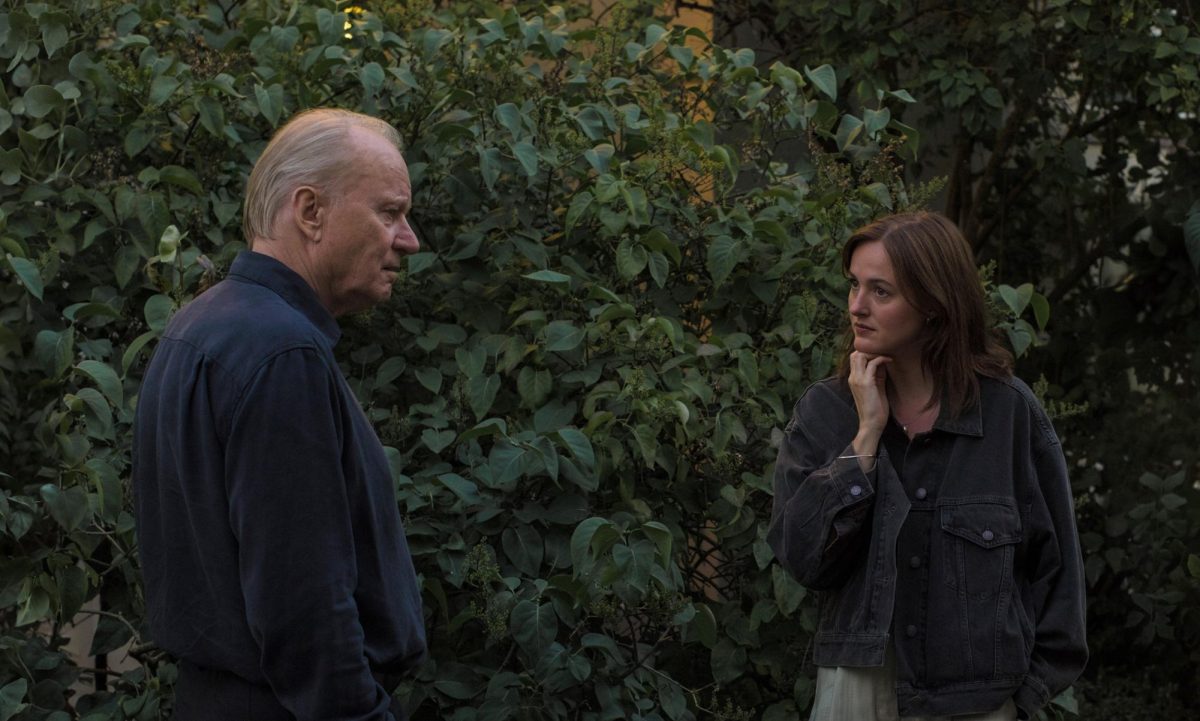
Four years after the release of their modern classic “The Worst Person in the World,” filmmaker-actor duo Joachim Trier and Renate Reinsve return with another exemplary film, “Sentimental Value,” released Nov. 7.
Winner of the Grand Prix at the Cannes Film Festival earlier this year, “Sentimental Value” follows director Gustav Borg (Stellan Skarsgård) and his daughters Nora (Reinsve) and Agnes Petterson (Inga Ibsdotter Lilleaas) as Gustav plans his next film about their family history with Nora, a stage actress, in mind as the lead. After she declines the role, Gustav offers the role to young American actress Rachel Kemp (Elle Fanning), whose presence disrupts the already complicated family dynamics.
Skarsgård gives a phenomenal performance as Gustav, a film director using the art form to attempt to reconnect with his daughters. Skarsgård plays Gustav with a quiet and stern sensibility that leaves a profound impact on the viewer as they realize the connections his script has with his personal life.
Reinsve is incredible as Nora, an actress who puts everything she feels and is into her career. Lilleaas gives a standout performance as Agnes, perfectly delivering two of the most emotional scenes in the film that examine her role as a mediator for her sister and father.
Rounding out the ensemble, Fanning exceptionally illustrates Rachel’s feelings, knowing that she was a replacement for Nora, and knowing that she will never be able to deliver the performance that Gustav truly wants. Having her dye her hair and change accents, Gustav changes Rachel to a point where she does not recognize both herself and the role she originally wanted to play. By using Rachel as a metaphor for how you can never truly change the family you are born to be a part of, both Trier and Fanning deliver one of the most impactful characters and performances of the year so far.
Trier purposefully has his directorial style differ from Gustav’s, at least in the beginning. In an important scene of “Sentimental Value,” the audience sees a scene from one of Gustav’s films. The scene consists of a little girl evading capture on a train (later revealed to be a younger Agnes) while her brother gets taken. The camera shows everything at a distance at first, but eventually slowly zooms in on the young girl as tears fall down her face, all done in one long take.
The camerawork is delicate and intimate, focusing on the details that surround the characters. Throughout the film, the camerawork slowly becomes more of what the audience saw in Gustav’s film, leading the audience to wonder if they are watching a Trier film or watching Gustav’s film about his family.
The house the Borg family lives in is its own character. The opening scene depicts Nora as she grows up and writes about how the house is “collapsing in slow motion.” After the death of their mother, Nora and Agnes look through her things at the same house, their grieving quickly interrupted when Gustav shows up to tour the house to Rachel. The house is renovated twice, both by Gustav when he tries to change not only the house, but the relationships he has with his family. By using the house as symbolism for family connections, Trier masterfully showcases how homes can bring families together and tear them apart just as quickly.
Agnes, despite starring in one of Gustav’s films at a young age, started a family and began working a more stable job when she became older. Nora, on the other hand, buries herself into her art. A pivotal scene, after Gustav is insensitive and disrespectful to Nora, cuts to Nora sobbing, with the camera slowly zooming out to reveal that she was on stage the entire time. Through this scene, the audience gets an understanding of the way Nora uses acting as her own personal form of therapy.
The Borg family is shown communicating best through art. Gustav communicates with his scripts, writing his latest film about the life of his late mother. Nora communicates through her performances. At many points Nora hesitates to go on stage, representing how she hesitates to properly talk with the people in her life, specifically her father.
“Sentimental Value” proves itself to be one of the greatest films of the year thus far with its masterful direction and performances. By beautifully depicting how and why artists use their professions to help their own lives, “Sentimental Value” is an important film fated to leave an impact on viewers.