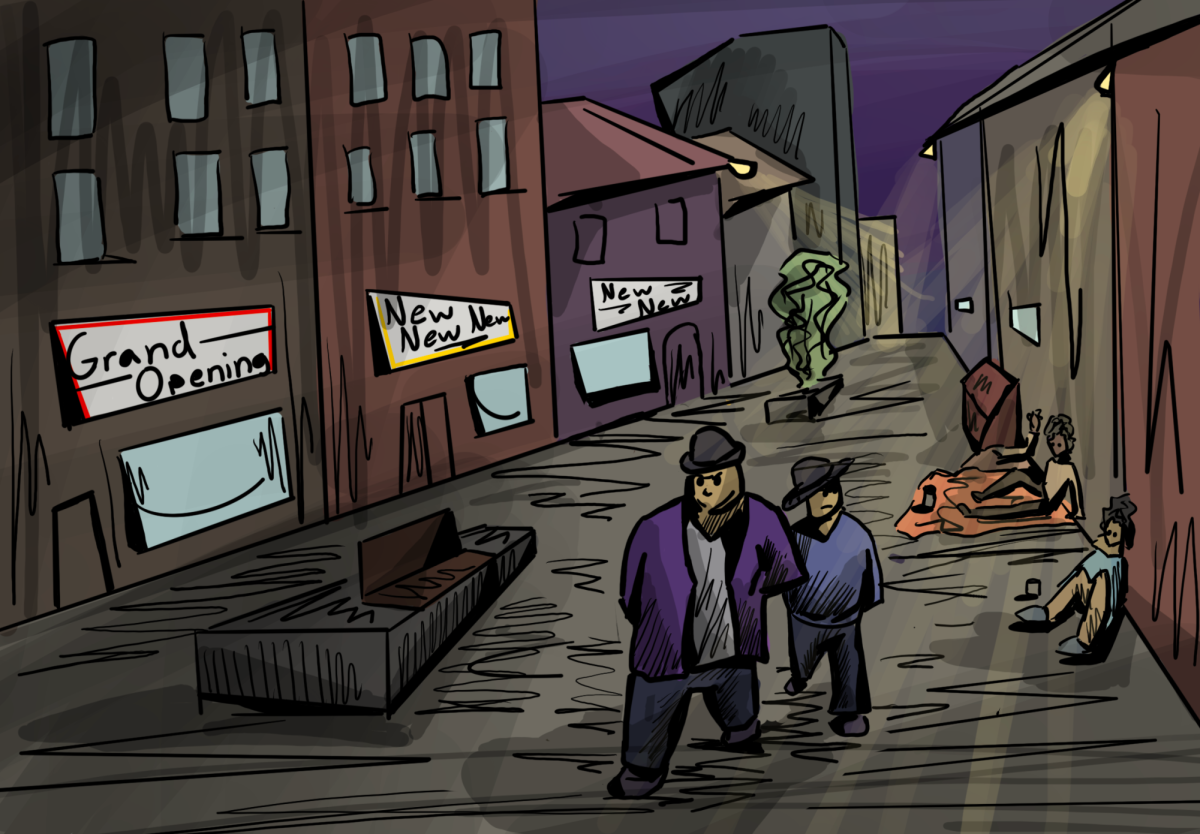

Earlier this year, the Buckeye Institute, an independent research think tank “whose mission is to advance free-market public policy” across the U.S., testified before the Ohio Senate Higher Education Committee to pass Senate Bill 1. The bill, passed June 27, most notably ensures that all accredited colleges and universities in the state do not have to mandate diversity, equity and inclusion policies and should cut certain programs to narrow collegiate degrees to ones that will “meet the challenges of the 21st-century workplace.”
Just a few short months later, April 21, the University of Toledo released a statement that said it was suspending admission to degrees in majors that include Africana studies, Middle East studies and women’s and gender studies to comply with S.B. 1.
Ohio, however, is not the only state to start suspending such majors. Colleges and universities in states like Florida, Iowa, Texas, West Virginia, Alabama, among others, are erasing programs and courses that discuss topics of systemic racism, sex, oppression, gender and even courses that discuss microaggressions.
Such action from states comes at a time when political division seems to be at a peak in the U.S.; as young White men incubate in online echo chambers of white “bro-casters” that speak about white supremacy, ending “wokeness” and targeting feminism; and as policies from our country’s current administration seek to kill DEI.
The only result of the lack of mandating DEI has become the censorship of the nation’s higher education. Laws like S.B. 1 allow colleges and universities to cherry pick their narratives of the past and ongoing history.
It seems to me that such legislation will not be preparing any student for the 21st century — a century that, like every other, is filled with people of all cultures, backgrounds and genders.
However, students attending college in New York state — which has not curtailed DEI courses in higher education — should not and cannot sit idly by as other states suspend inclusive teaching initiatives. We can all learn from the activist style of the women’s liberation movement in the 1970s, propelled by (but not started by) journalist and activist Gloria Steinem.
It was the talking circles, Steinem writes in her memoir, “My Life on the Road,” that got social change motivated in the ’70s. In her memoir, she begins with tales of her early childhood and how they eventually morphed into the makings for an activist’s lifestyle.
Growing up on summer road trips with her father, Steinem was accustomed to traveling cross country when she eventually became a women’s rights activist and public speaker. Although she spoke at government conventions, Steinem writes that her favorite place to speak was on college campuses. It was in those academic spaces that the talking circle became a mode for social change.
Steinem was inspired to initiate talking circles as an activist after living in India for two years and after traveling to indigenous areas of Alaska. The talking circle has not only been a long-lasting tool for communication, but became a symbol of the women’s rights movement in the U.S.
Women developed the foundations for the modern feminist movement in talk circles, they shared early feminist theory and had feminist “click” moments — where women came to realize, through discussion, that the everyday misogyny and abuse they endured was not tolerable. Steinem’s New York City apartment is still a space where talking circles regularly convene.
Although the feminist movement of the 1970s was far from perfect — highlighting the voices of White women, while only sparingly including women of color — their mode of speaking, creating community and making decades-long, impactful change is something young people should rally behind. Online spaces seem to have become the new talking circle, but are much more expansive and far-reaching. However, with increases in AI and the spread of mis- and disinformation, perhaps we should reconvene the talking circle, in the very least, on college campuses.